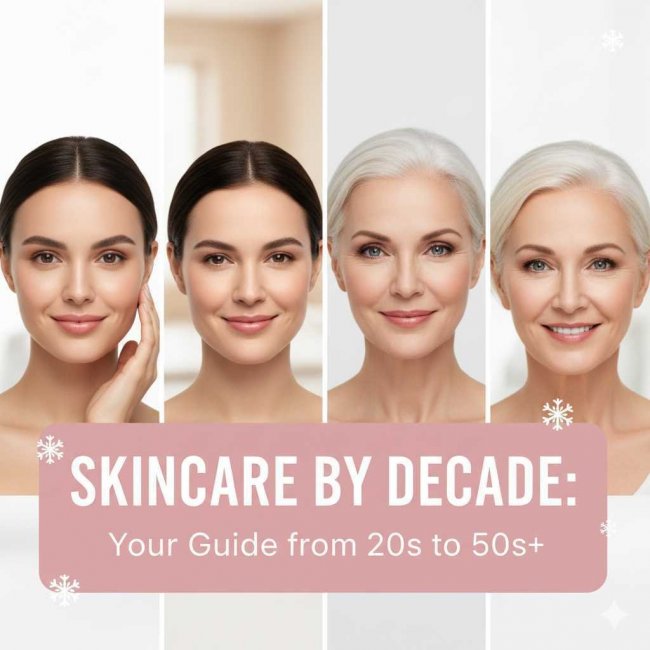
Skin Longevity & Advanced Skincare: The Modern Guide to Healthier, Younger-Looking Skin
For years, skincare has been dominated by one question: “How do I get rid of wrinkles?”
Today, the conversation is changing.
The newest approach to beauty is skin longevity—a long-term strategy focused not simply on making skin look younger, but on maintaining its strength, resilience, hydration, even tone and healthy appearance for as long as possible.
Instead of waiting for visible signs of aging and trying to reverse them, skin longevity encourages us to protect the skin early, support its natural functions and choose proven ingredients consistently.
Think of it as skincare for the future.
What Is Skin Longevity?
Skin longevity is the idea of supporting healthy skin over time by addressing both intrinsic aging—the natural biological changes that occur as we get older—and extrinsic aging, which is influenced by factors such as ultraviolet radiation, pollution, smoking and other environmental exposures.
The skin's ability to renew itself changes with age. Collagen and elastin production gradually decline, the skin barrier can become less efficient, and pigmentation, dryness, fine lines and changes in firmness can become more noticeable.
But chronological age tells only part of the story.
Sun exposure is one of the most important external contributors to visible skin aging. Dermatologists refer to this as photoaging, which can include wrinkles, uneven pigmentation, rough texture and loss of elasticity.
That is why modern longevity skincare begins with prevention rather than chasing a miracle product.
The Foundation: Protect Your Skin Every Morning
If I could give one skincare recommendation after two decades of following beauty and dermatology trends, it would be this:
Protect your skin from the sun every day.
A sophisticated routine filled with expensive serums cannot compensate for inconsistent sun protection.
The American Academy of Dermatology recommends a broad-spectrum sunscreen with SPF 30 or higher, particularly when spending time outdoors. Sun protection is considered a foundation of an effective anti-aging skincare routine.
Sunscreen also has another advantage: it helps prevent additional UV damage while you are using other ingredients designed to improve the appearance of photoaged skin.
Your morning foundation:
Gentle cleanser, if needed
Antioxidant serum
Moisturizer
Broad-spectrum SPF 30+ sunscreen
Don't forget commonly missed areas such as the neck, ears, chest and hands.
And remember: sunscreen is not just for beach days. UV exposure occurs throughout the year.
Retinoids: The Ingredient That Still Matters
Beauty trends come and go. Retinoids have remained important for a reason.
Retinoids are vitamin A derivatives with extensive dermatological research behind them. They can help improve the appearance of fine lines, uneven pigmentation and skin texture, while prescription tretinoin has particularly strong evidence for photoaging.
Retinol is a weaker, cosmetic form that is widely available without a prescription.
The important word here is consistency.
Retinoids aren't overnight treatments. Visible improvement can take months, and continued use is generally necessary to maintain results.
But more is not necessarily better.
Starting with a strong retinoid every night can leave the skin dry, irritated and uncomfortable. A better approach for many beginners is to introduce a lower-strength product gradually—perhaps two or three nights per week—and increase frequency as the skin becomes accustomed to it.
If your skin is very sensitive, reactive or prone to redness, speak with a dermatologist before beginning a retinoid routine.
Peptides: The Modern Supporting Player
Peptides have become one of the most talked-about ingredients in contemporary skincare.
They are short chains of amino acids that can be incorporated into cosmetic formulations for different purposes. Some topical peptides are designed to support the appearance of firmness and smoother-looking skin.
However, this is where an expert approach is important.
Not every product containing the word “peptide” will produce dramatic results, and cosmetic formulations differ considerably.
The current beauty conversation around peptides also includes injectable products and so-called longevity therapies. These should not be confused with topical cosmetic peptides. Injectable substances can involve very different risks and regulatory considerations.
For everyday skincare, stick with reputable topical formulations and realistic expectations.
Antioxidants: Your Daily Defense Team
Antioxidants are another important part of advanced skincare.
One of the most familiar is vitamin C.
A well-formulated topical vitamin C product can help improve the appearance of uneven skin tone and support the skin against environmental oxidative stress. It is particularly useful in a morning routine before sunscreen.
Other antioxidant ingredients found in skincare include vitamin E, ferulic acid, green tea extracts and various plant-derived compounds.
The goal isn't to create a complicated cocktail of ten antioxidant serums.
Choose one well-formulated product and use it consistently.
Don't Forget the Skin Barrier
One of the biggest changes in skincare thinking has been the recognition that healthy-looking skin depends on a healthy skin barrier.
The barrier helps maintain hydration and protects the skin from external irritants. When it becomes compromised, the skin may feel tight, dry, rough or unusually sensitive.
This is why aggressive exfoliation can actually work against your long-term beauty goals.
A common mistake is combining a retinoid, several acids, scrubs and multiple active serums because more ingredients appear to promise faster results.
The opposite can happen.
I often recommend thinking of skincare as a balance between stimulation and recovery.
Active ingredients provide targeted treatment.
Moisturizers and barrier-supportive ingredients provide comfort and hydration.
Your skin needs both.
Look for ingredients such as:
Ceramides
Glycerin
Hyaluronic acid
Niacinamide
Squalane
Fatty acids
If your skin is irritated, simplify your routine rather than adding another “repair” serum.

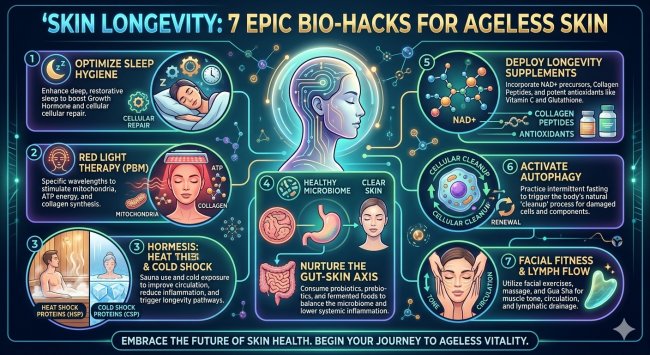
What About Red-Light Therapy?
LED and red-light devices have moved from professional clinics into home bathrooms, making beauty technology one of the most exciting areas of modern skincare.
At-home LED masks are marketed for concerns ranging from fine lines to overall skin appearance.
The important distinction is between promising technology and proven outcomes.
Device quality, wavelength, energy output, treatment time and consistency all matter. A beautiful-looking LED mask isn't automatically an effective one.
If you are considering an at-home device, choose a reputable manufacturer, follow the manufacturer's instructions and consider discussing it with a dermatologist—especially if you have a skin condition or take medication that can increase light sensitivity.
Beauty technology should complement a good skincare routine, not replace it.
Advanced Skincare Does Not Mean More Products
This may be the most important lesson of modern skincare:
Advanced skincare is not the same thing as complicated skincare.
A 12-step routine isn't automatically better than a four-step routine.
In fact, dermatologists commonly recommend focusing on a small number of well-chosen products rather than using multiple anti-aging products simultaneously, because too many active ingredients can irritate the skin.
A simple longevity routine
Morning
Cleanse
↓
Vitamin C or antioxidant serum
↓
Moisturizer
↓
Broad-spectrum SPF 30+
Evening
Cleanse
↓
Retinoid/retinol on appropriate nights
↓
Moisturizer
↓
Vitamin C or antioxidant serum
↓
Moisturizer
↓
Broad-spectrum SPF 30+
Evening
Cleanse
↓
Retinoid/retinol on appropriate nights
↓
Moisturizer
On non-retinoid nights, you can focus on hydration and barrier support.
Once your basic routine is working well, you can consider adding a targeted ingredient for a specific concern such as pigmentation, acne or texture.
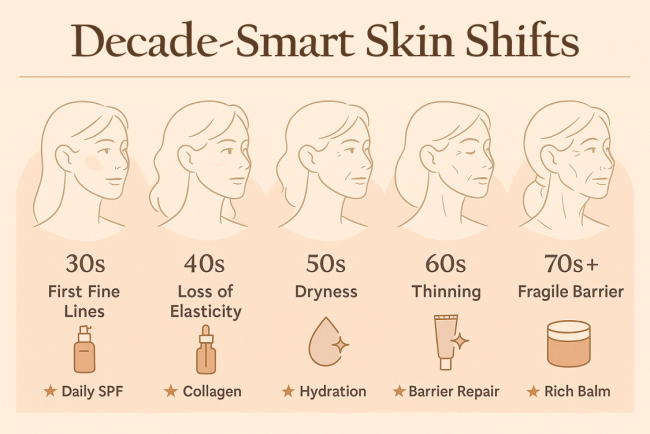
Skin Longevity in Your 20s, 30s, 40s and Beyond
There is no single perfect routine for every woman.
Your 20s
Think prevention and foundation.
Prioritize sunscreen, gentle cleansing, hydration and—when appropriate—antioxidants or a retinoid.
Don't feel pressured to use powerful anti-aging products simply because they're trending.
Your 30s
This can be an excellent time to become more consistent.
Sun protection, vitamin C, retinoids and barrier-supportive moisturizers can form the foundation of a sophisticated routine.
Your 40s
Hydration and barrier support often become increasingly important.
You may also notice changes in pigmentation, texture and firmness. Rather than adding five new products, identify your primary concern and choose one targeted treatment.
Your 50s and Beyond
Skin may become drier and more sensitive as hormonal and biological changes occur.
Gentle cleansing, rich moisturization, sunscreen and carefully selected active ingredients become especially important.
The goal isn't to make mature skin look artificially young.
The goal is healthy, radiant, well-cared-for skin at every age.
The Beauty Myth We Should Leave Behind
One of the biggest misconceptions in beauty is that aging skin is automatically unhealthy skin.
It isn't.
Fine lines are normal. Changes in facial structure are normal. Gray hair is normal. Mature skin is normal.
Skin longevity isn't about fighting your age.
It's about protecting the biological health and appearance of your skin so that it remains comfortable, resilient and luminous throughout life.
That is a much more sustainable—and realistic—definition of beauty.
The Skin Longevity Checklist
If you want to simplify everything you've read, start here:
Every morning:
☐ Broad-spectrum SPF 30+
☐ Antioxidant serum if appropriate
☐ Moisturizer
☐ Protect your face, neck, chest and hands from excessive sun exposure
Every evening:
☐ Gentle cleansing
☐ Retinoid/retinol if appropriate
☐ Barrier-supportive moisturizer
Every week:
☐ Avoid excessive exfoliation
☐ Give irritated skin time to recover
☐ Assess whether your routine is actually working
Every year:
☐ Review your skincare routine
☐ Have suspicious or changing skin lesions evaluated by a dermatologist
☐ Reassess products based on your skin's current needs rather than your age alone
The future of skincare isn't about finding one magical ingredient.
It's about long-term skin health.
Protect your skin from UV exposure. Use evidence-supported ingredients such as retinoids when appropriate. Maintain the skin barrier. Introduce new products gradually. Treat specific concerns instead of attacking every possible sign of aging at once.
And most importantly, give your routine time to work.
The most effective skincare routine isn't necessarily the most expensive or the most complicated.
It's the one you can use consistently, comfortably and intelligently for years.
Skin longevity is not about stopping time. It's about making every stage of your skin's journey healthier.
You can help this site by reposting its publications on social networks (Facebook, X (Twitter), Google and others)
Subscribe to our Telegram channel https://t.me/beautifulme_ca/ and YouTube channel


